

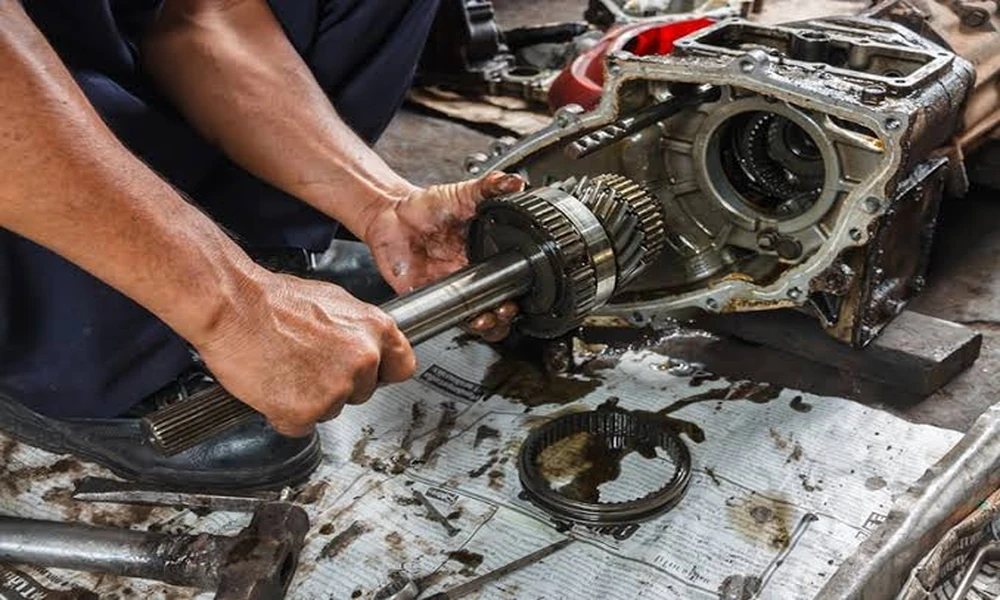
A transmission is the most expensive component most drivers know the least about, and the failures that end up on a lift at Mountain Transmission Centers usually started as something small and ignorable. A slight shudder at highway speed. A half-second pause before the car moves in the morning. Fluid that went from red to brown two years ago. Knowing what the unit does, what kills it, and what the early symptoms actually sound like is the difference between a fluid service and a rebuild.
What does a transmission actually do?
It matches engine speed to wheel speed so the engine can stay in the narrow range where it makes usable power. An engine that produces its torque between 1,800 and 5,000 rpm cannot drive wheels turning at everything from a crawl to highway speed, so the transmission multiplies torque at low speeds and reduces engine rpm at cruise.
An automatic does this with planetary gearsets, clutch packs, and a torque converter, which is a fluid coupling that lets the engine keep running while the car sits still. Hydraulic pressure generated inside the unit applies those clutches, and a valve body full of electrically controlled solenoids decides which ones engage. That is why so many transmission problems turn out to be electrical or hydraulic rather than mechanical.
What kind of transmission does your car have?
Four designs cover nearly everything on the road, and they fail in different ways.
- Conventional automatics use planetary gearsets and now commonly run 8, 9, or 10 forward speeds. Failures cluster in solenoids, valve bodies, and clutch packs.
- Continuously variable transmissions, or CVTs, use a steel belt or chain running between variable-width pulleys instead of fixed gears, which is why engine speed seems to hold steady while the car accelerates. They are highly sensitive to fluid conditions and overheating.
- Dual clutch transmissions are essentially automated manuals with two clutches, one for odd gears and one for even. Low-speed shudder and clutch wear are the usual complaints.
- Manuals fail at the clutch disc, pressure plate, and throwout bearing far more often than in the gearbox itself.
Electric vehicles mostly use a single-speed reduction gear, which sidesteps almost all of this.
Why does heat destroy transmissions?
Because automatic transmission fluid oxidizes rapidly above its designed operating range, and once the fluid degrades, everything it protects starts wearing. ATF is doing four jobs at once: transmitting hydraulic pressure, lubricating, carrying away heat, and providing precise friction characteristics so clutches grab without slipping.
Most automatics are happiest with fluid somewhere in the 175 to 200°F range. A widely used industry rule of thumb holds that fluid life is roughly halved for every 20°F of sustained operation above that, and sustained temperatures in the 240°F range attack seals and clutch material quickly.
Grades and towing are where that heat comes from. Climbing a long pass with a trailer keeps the torque converter unlocked and slipping, which converts engine power directly into heat. Altitude compounds it, since naturally aspirated engines lose roughly 3 percent of their power per 1,000 feet of elevation as a rule of thumb, so the transmission downshifts more often and hunts between gears on a climb that would be effortless at sea level.
Is “lifetime fluid” real, and how often should you service it?
Lifetime means the manufacturer’s design life, not yours. Plenty of owner’s manuals list no scheduled ATF change under normal use while also defining a severe service schedule that calls for fluid replacement somewhere in the 30,000 to 60,000 mile range.
Read that severe service definition carefully, because it typically includes trailer towing, mountainous terrain, and sustained stop-and-go driving. If you live where the roads climb, you are on a severe schedule regardless of what the normal column says.
Fluid specification is not negotiable. Dexron VI, Mercon LV, ATF+4, Toyota WS, Honda DW-1, and the various CVT fluids are chemically distinct, and a universal fluid poured into a unit that wants a specific formulation causes shudder and clutch glazing. Understand also that a simple drain and fill typically exchanges only 40 to 50 percent of the fluid, since much of it stays in the torque converter and cooler lines.
What are the early warning signs?
Delayed engagement is usually first. You shift into drive, and the car pauses a beat before moving. Other symptoms worth acting on:
- Engine rpm rising without matching acceleration, which is slipping
- A vibration or shudder at light throttle around 35 to 50 mph, often torque converter clutch related
- Harsh, banging, or flaring shifts that changed recently
- A whine or hum that rises and falls with vehicle speed
- Fluid that smells burnt or has gone dark brown instead of red
- A check engine light with a P07xx series code
Red or pink fluid on the driveway is transmission or power steering. Dark brown or black is engine oil. Puddle color tells you where to look.
How should you drive to protect it?
Use engine braking on descents instead of riding the brakes, and let the transmission hold a lower gear. Tow/haul mode is not just for trailers, it changes shift scheduling and grade-braking behavior in ways that reduce heat and brake fade on long downhill runs.
Towing regularly justifies an auxiliary transmission cooler, which is a comparatively inexpensive addition against the cost of a rebuild. Stay within the vehicle’s rated towing capacity, come to a complete stop before shifting between drive and reverse, and do not rock a stuck vehicle back and forth for long stretches.
What should a diagnosis at Mountain Transmission Centers involve?
A scan for stored codes, a fluid level and condition check, a road test with the technician driving, and a line pressure test where the symptoms warrant it. Plenty of complaints that feel like transmission trouble turn out to be an engine misfire, a failing motor mount, a wheel speed sensor, or simply low fluid.
Expect a fluid service to run somewhere around $150 to $400, solenoid or valve body work in the $400 to $1,500 range, and a full rebuild or remanufactured replacement commonly between $2,500 and $7,000 depending on the vehicle. Ask whether the quote covers the torque converter and what the warranty terms are, since those two answers explain most of the spread between competing estimates.
Transmissions rarely fail without warning. They get hot, the fluid degrades, the shifts change character, and someone decides to wait another few thousand miles. Check your fluid, read the severe service schedule in your manual, and bring anything that shudders or slips to Mountain Transmission Centers while it is still a diagnosis instead of a rebuild.
