

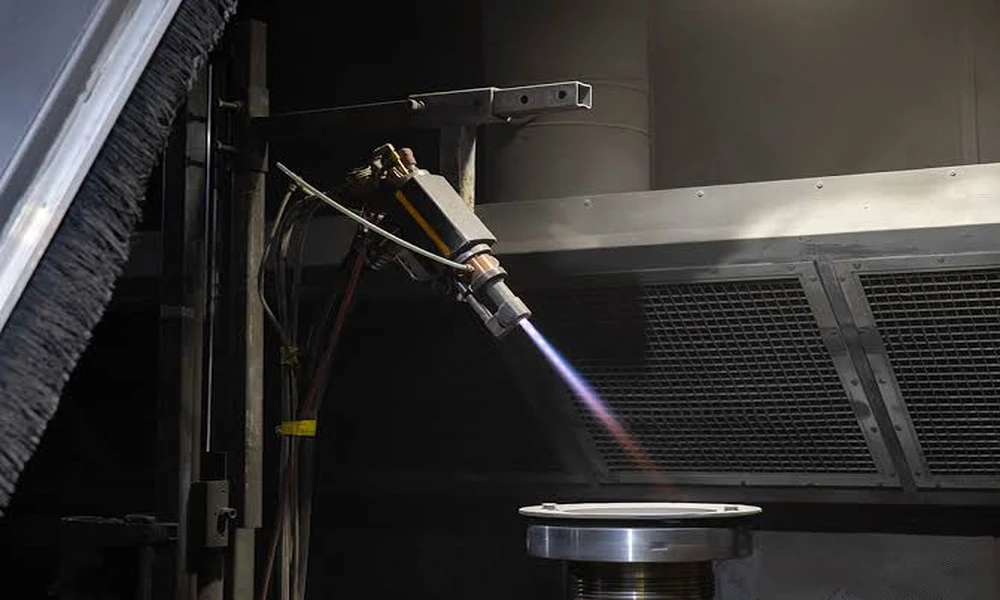
Thermal spray coatings have become an essential part of component protection strategies across aerospace, oil and gas, power generation, mining, and heavy engineering industries where surface wear, corrosion, and thermal degradation are significant drivers of component failure and replacement cost. Among the thermal spray processes available, HVOF coatings and HVAF spray represent the highest-performance options for dense, well-bonded metallic and cermet coatings whose properties approach or match those of the corresponding bulk material. Understanding how these processes work, what applications they serve, and how HVOF coatings and services are specified helps engineers and procurement teams make informed decisions about surface engineering for high-value components.
What are HVOF coatings?
HVOF coatings are applied through the High Velocity Oxygen Fuel thermal spray process, in which a fuel gas, typically hydrogen, propylene, or kerosene, is combusted with oxygen in a high-pressure combustion chamber. The resulting high-velocity exhaust stream, moving at supersonic velocities of 1,500 to 2,000 metres per second or above, carries the coating material particles from the powder feeder, heats the option to a plastic or partially molten state, and accelerates the option onto the substrate surface. The high particle velocity at impact produces coatings with:
- Low porosity: HVOF coatings typically achieve porosity levels below 1 per cent, and in optimised process conditions below 0.5 per cent, compared to 5 to 15 per cent for conventional flame spray coatings.
- High bond strength: the mechanical interlocking of the high-velocity splats with the prepared substrate surface produces adhesive bond strengths exceeding 70 MPa in quality HVOF deposits, compared to 20 to 40 MPa for plasma spray.
- Compressive residual stress: the peening effect of high-velocity particle impact produces compressive residual stress in the coating, which improves fatigue resistance and reduces the risk of coating delamination in cyclic loading applications.
- Minimal thermal degradation: the relatively low particle temperature in HVOF compared to plasma spray reduces oxidation and phase decomposition of sensitive coating materials, particularly important for WC-Co cermet coatings where carbide dissolution degrades wear resistance.
What is HVAF spray and how does it differ from HVOF?
HVAF spray (High Velocity Air Fuel) is a variant of the high-velocity thermal spray process in which compressed air replaces the oxygen component of the combustion mixture. The use of air rather than pure oxygen reduces the flame temperature while maintaining high particle velocities, producing coatings with even lower oxidation and phase transformation than HVOF for temperature-sensitive materials.
The principal differences between HVAF spray and HVOF that drive the selection between the two processes:
- Particle temperature: HVAF produces lower particle temperatures than HVOF, which is advantageous for cermet coatings where carbide phase stability is critical and for metallic coatings whose chemistry is sensitive to oxidation at elevated temperatures.
- Particle velocity: modern HVAF systems achieve particle velocities comparable to or exceeding HVOF, producing similarly dense, well-bonded coatings despite the lower particle temperature.
- Operating cost: air is substantially less expensive than industrial oxygen, and the HVAF process consumes less fuel per unit of coating deposited than HVOF, reducing the operating cost of the spray process for high-volume applications.
- Deposition rate: HVAF systems typically achieve higher deposition rates than HVOF for equivalent coating quality, reducing processing time for large component surfaces
What materials are applied as HVOF coatings?
HVOF coatings and services cover a range of coating materials matched to the specific protection requirements of each application:
- WC-Co and WC-CoCr cermet coatings: the most widely applied HVOF coatings for sliding wear, abrasion, and erosion resistance. The tungsten carbide hard phase embedded in the cobalt or cobalt-chromium matrix provides exceptional hardness and wear resistance, while the metallic binder provides the toughness that brittle ceramic coatings lack.
- Chromium carbide-NiCr coatings: specified for elevated temperature wear and oxidation resistance applications where WC-Co would be inappropriate due to its limited oxidation resistance above 500 degrees Celsius.
- MCrAlY bond coats: the metallic oxidation-resistant bond coats applied under thermal barrier coating systems in gas turbine components, where the dense, well-adhered HVOF deposit provides superior oxidation resistance compared to plasma-sprayed bond coats.
- Stainless steel and nickel alloy coatings: corrosion-protective metallic coatings for marine, chemical processing, and pump component applications where the substrate material requires protection from aqueous or chemical corrosion.
What industries use HVOF and HVAF coatings?
The applications of HVOF coatings and HVAF spray span virtually every industry sector that operates components subject to surface degradation:
- Aerospace: landing gear components, hydraulic actuator cylinders, compressor blades, and the bearing surfaces of rotating machinery where the coating must provide wear resistance without adding significant weight or compromising dimensional tolerances.
- Oil and gas: pump plungers, valve trim components, mud pump liners, and offshore platform components subject to simultaneous abrasion, erosion, and corrosion in produced fluid service.
- Power generation: gas turbine compressor blades and vanes, steam turbine blade roots and seal faces, and boiler tube components subject to high-temperature erosion and corrosion.
- Mining and mineral processing: crusher wear components, slurry pump impellers and casings, and the high-wear surfaces of conveying and classification equipment.
Conclusion
HVOF coatings, HVOF coatings and services, and HVAF spray technology represent the highest-performance thermal spray options for components requiring dense, well-bonded surface protection against wear, corrosion, and high-temperature degradation. The selection between HVOF and HVAF processes depends on the coating material’s temperature sensitivity, the required deposition rate, and the operating cost considerations of the production environment.
Thermal spray coating services can support industrial applications requiring advanced surface protection across aerospace, oil and gas, power generation, and heavy engineering sectors. These services can cover a range of HVOF coatings including WC-Co cermet, chromium carbide, MCrAlY, and metallic corrosion-protective coatings, with engineering expertise and process control suited to demanding industrial applications.
