

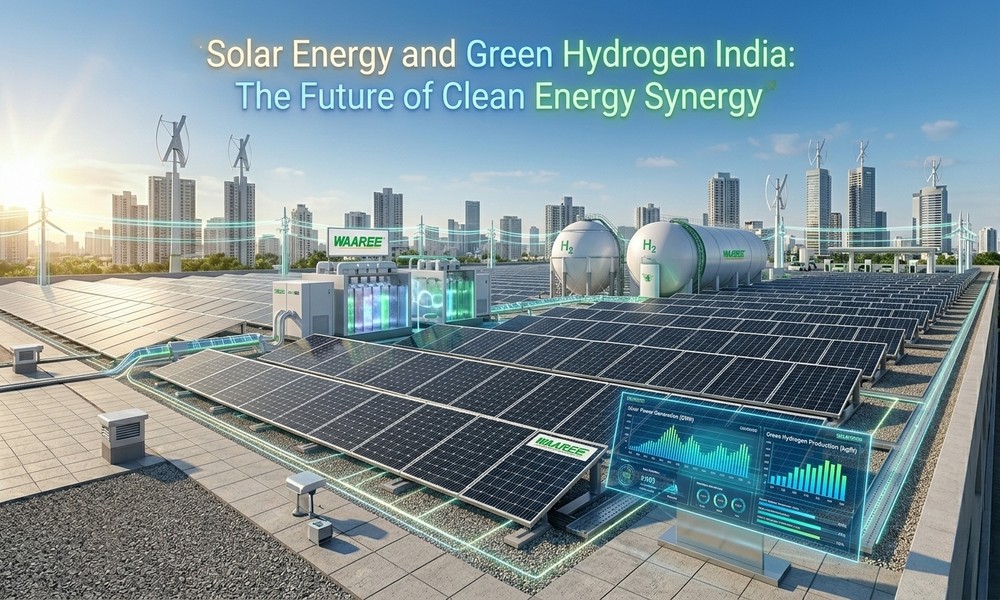
As the country prepares for an environmentally friendly future, the interaction of solar energy and green hydrogen technology has proven to be a potential breakthrough in the field of sustainable energy production. The combination of these two factors will play a key role in India’s future energy generation, storage, and utilization.
The Synergy Between Solar Energy and Green Hydrogen
One of the most popular sources of energy is solar power. In particular, by 2025, India’s solar energy production exceeded 100 GW. Yet, one disadvantage of solar energy is that it cannot always provide a constant flow of energy due to the variability of weather conditions.
To overcome this problem, the country should focus on developing green hydrogen technology. The reason for this is that using solar energy to separate water into molecules yields green hydrogen, which can be stored and distributed in sectors such as steelmaking, sea transportation, and the aviation industries.
Latest Advances in Solar-Powered Hydrogen Production
Recent technological breakthroughs are making solar hydrogen synergy increasingly viable. High efficiency electrolysers now convert solar electricity to hydrogen at efficiencies of up to 80%, making large-scale production commercially feasible. Photocatalytic water splitting research, actively pursued by institutions like IIT Madras, aims to directly split water using sunlight, eliminating the electricity generation step and reducing costs further. Concentrated Solar Hydrogen systems use high-temperature thermochemical processes powered by concentrated solar energy, offering another efficient production pathway.
India’s Green Hydrogen Mission and 2026 Progress
The government launched the National Green Hydrogen Mission in January 2023 with an outlay of Rs 19,744 crore, targeting 5 million tonnes of annual production by 2030. Key initiatives include viability gap funding, electrolyser manufacturing incentives, and pilot projects across steel, shipping, and aviation. Domestic electrolyser manufacturing is gaining momentum with PLI incentives accelerating capacity buildout nationwide.
Challenges on the Path Forward
Cost remains the primary barrier, though green hydrogen prices are projected to reach parity with fossil fuel alternatives by 2030. Water availability, hydrogen storage infrastructure, and safety standards are additional areas requiring focused attention and investment.
Waaree Energies: Powering India’s Green Hydrogen Future
Leading the way in this transformation is Waaree Energies, which is the largest manufacturer of solar modules in India. Apart from being a solar manufacturer, Waaree is also investing in the production of green hydrogen and electrolyzers, thereby transforming itself into a total clean energy firm. Through its green energy business division, Waaree has commenced green hydrogen projects all around India, integrating both solar technology and hydrogen technology together to provide a comprehensive solution to green energy production. Leveraging on years of experience in the solar business as well as its foray into hydrogen, Waaree is best positioned to assist India in meeting its goals related to green hydrogen production.
